
Part Two: When Monogamy Became Social Law
In Part One of this series, we explored a reality many people never hear discussed:
Early humans likely practiced far more flexible relationship structures than modern society assumes.
Pair bonding existed. Love existed. Commitment existed.
But strict lifelong sexual exclusivity as a universal rule? History suggests that came much later.
So the obvious question becomes:
If monogamy was not humanity’s original default…how did it become the dominant moral expectation of Western civilization?
The answer lies in three powerful forces that reshaped human society forever:
- property,
- power,
- and religion.
Everything Changed When Humans Stopped Roaming

For most of human history, people lived nomadic lives. Then agriculture happened.
Around 10,000 years ago, humans began settling into permanent communities. Land could now be owned. Crops could be stored. Wealth could accumulate.
For the first time in history, people had something substantial to pass down to future generations.
And suddenly, paternity mattered in a completely different way.
A man who spent years building land, livestock, or status wanted confidence that his children, and his heirs, were biologically his. This changed everything. Monogamy began evolving not just as a relationship structure, but as a social and economic tool.
Monogamy Created Stability
As civilization expanded, societies faced a tough challenge:
How do you prevent constant competition among men for access to women, status, and family legacy?
History repeatedly showed that when a small number of powerful men monopolized large numbers of women, instability followed:
- resentment,
- violence,
- fractured communities,
- and social unrest.
Monogamy offered a solution. By encouraging one man and one woman to pair together, societies distributed partnership opportunities more evenly across the population. This reduced competition and increased stability.
In many ways, monogamy became less about romance… and more about social order.
And social order is incredibly valuable to civilizations trying to survive.
Religion Did Not Invent Monogamy. It Reinforced It
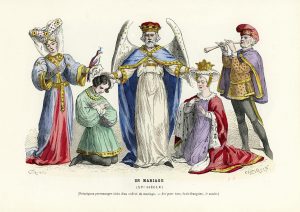
One of the most common assumptions in Western culture is that monogamy began as a direct command from God.
Historically, that is not entirely accurate. The Old Testament contains numerous examples of respected biblical figures with multiple wives and concubines:
- Abraham
- Jacob
- David
- Solomon
While these relationships often produced conflict and jealousy, they were not universally condemned as immoral. The major shift came later.
As Christianity spread through the Roman world, sexual behavior became increasingly framed not merely as social conduct, but as morality itself.
The writings of Paul the Apostle placed strong emphasis on:
- sexual restraint,
- fidelity,
- and exclusive partnership.
Over time, church leaders elevated monogamy from a practical arrangement to a sacred moral ideal. And eventually, what had once been one relationship structure among many became viewed as the only righteous one.
From Social Structure to Moral Obligation
This is one of the most important shifts in human relationship history.
Monogamy stopped being simply:
- useful,
- practical,
- or stabilizing.
It became associated with:
- purity,
- virtue,
- discipline,
- and spiritual obedience.
At the same time, non-monogamy increasingly became associated with:
- temptation,
- weakness,
- selfishness,
- or immorality.
But history reveals something fascinating:
These beliefs were not born all at once from a single divine decree. They developed gradually alongside changing civilizations, religious institutions, and social priorities. What many people now consider timeless moral truth was also deeply shaped by human systems trying to preserve order.
The Uncomfortable Reality Few People Discuss
The truth is, monogamy solved many real societal problems. Stable households helped civilizations grow. Clear inheritance structures protected wealth and lineage. Religious sexual ethics created predictable communities. None of that is inherently evil.
But recognizing monogamy’s social usefulness is not the same thing as proving it is humanity’s only natural or ethical relationship model. That distinction matters. Because something can be socially beneficial…without being universally suited for every human being.
So Where Does That Leave Us Today?
Modern society still treats monogamy as the unquestioned default.
Yet at the same time:
- infidelity remains common,
- divorce rates remain high,
- and countless people quietly struggle between emotional commitment and sexual curiosity.
Perhaps that tension exists because humans are trying to force a single universal structure onto a species that was never entirely uniform to begin with. Perhaps the real conversation should not be: “Which relationship structure is morally superior?”
But rather: “Which relationship structure creates honesty, fulfillment, respect, and consent for the people involved?”
That question changes everything.
Coming in Part Three…
If monogamy became socially and morally dominant over time, does that automatically make non-monogamy wrong?
Or have we confused cultural conditioning with universal truth?
In Part Three, we’ll explore the modern tension between monogamy, human biology, emotional bonding, and the growing conversation around ethical non-monogamy. Because the deeper many people look into human history…the harder it becomes to believe there was ever only one way humans were meant to love.